Support Menu and Project Pathways
The Translational Data Accelerator helps investigators access and use clinical and molecular data to accelerate translational research. We enable translational research by connecting teams to research-ready data, enabling data access through applications, and providing expert Data Science and Data Governance support through a tiered system.
Service Overview
Use this menu to identify the right starting point for your study, understand when services are available, and determine how to get started.
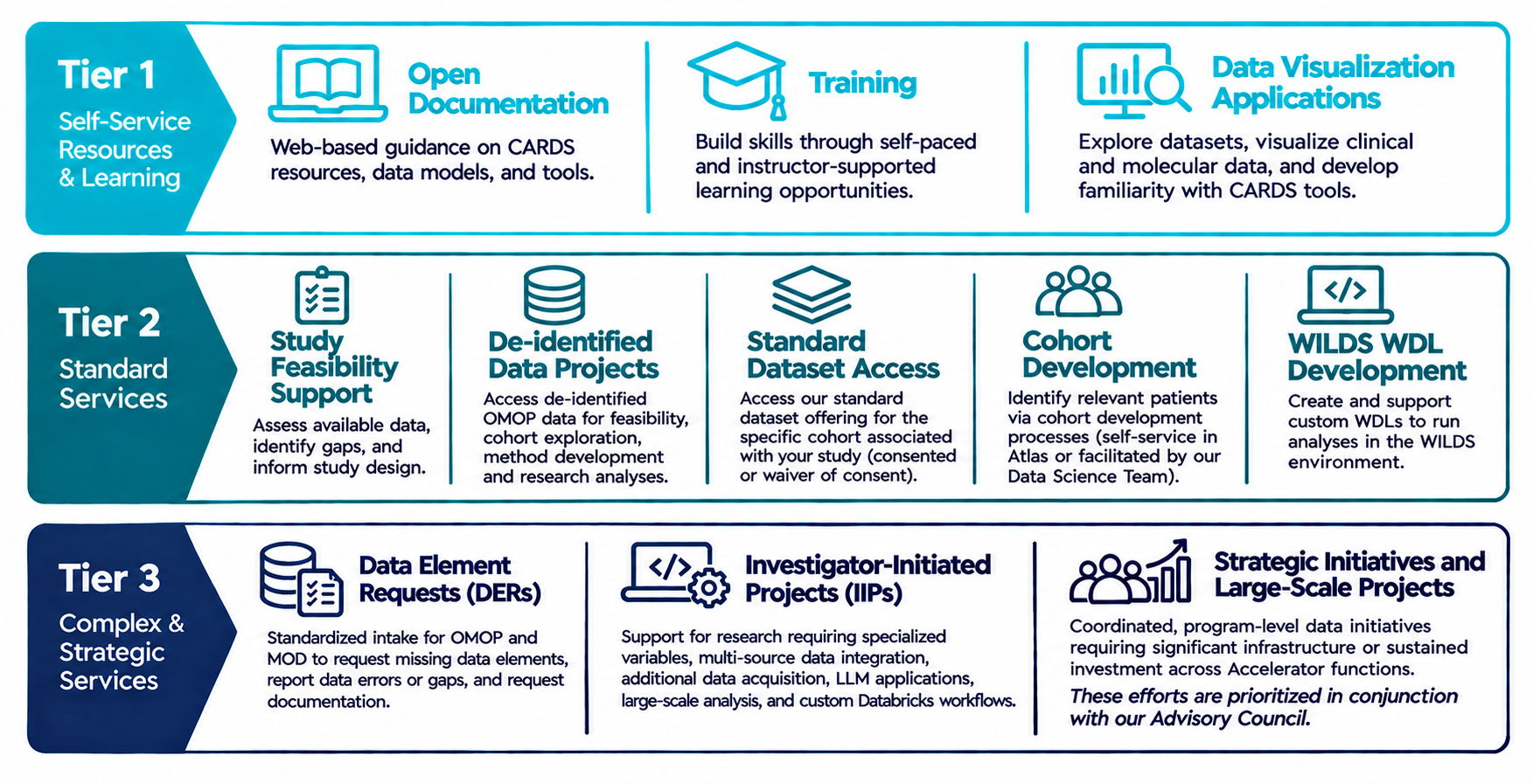
Tier 1 Services
Our Tier 1 services are all self-service resources we have available on our Resources page. These include links to documentation, training, peer to peer support and Deep Dives, some of which will have material posted in our tutorials page.
Tier 2 Services
Our Tier 2 services are by-request supports you can request and receive fairly quickly. They are often the basics you’ll need to get your started working with clinical data and are a great way to both get familiar with our more comprehensive data resources as well as build skills working with data in CARDS.
Study Feasibility Support
Availability: Available now
Our Data Science team provides study feasibility support for investigators to translate research questions into data requirements in light of what data are available, identify potential gaps or limitations, and determine what additional work may be needed to support the study.
This is an opportunity to address data questions early, before committing to a study design or a more complex data request.
Use this resource when:
- You’re planning a new study and want to know whether the necessary data exist already.
- You’re unsure whether the standard dataset contains the variables needed to answer your research question.
- You suspect your study will require specialized clinical variables, molecular data, or additional data sources.
- You need help understanding potential gaps or limitations in the data before finalizing a study design.
How to get started: Schedule a Translational Project Feasibility Data House Call with our Data Science staff to discuss your project.
De-identified Data Projects
Availability: Coming Soon
Not every research question requires access to identifiable patient data. Investigators can use de-identified data to assess study feasibility, evaluate whether available datasets can support a research question, develop or test analytical methods before moving into a study that requires patient-level identifiers or in many cases, perform complete research analyses.
We provide access to de-identified data from our OMOP and MOD datasets with a streamlined governance process appropriate to the intended use.
Use this resource when:
- You’re planning a new study and want to know how many patients meet your inclusion/exclusion criteria in our OMOP and MOD datasets (work preparatory to research).
- You’re unsure whether our OMOP and MOD datasets contains the variables needed to answer your research question.
- Your study does not need patient identifiers to be executed.
How to get started: Submit a RADaR request with your Not Human Research determination from the IRO or attest to your work being work preparatory to research.
Note: We can provide access to de-identified data in either Atlas or Databricks.
Standard Dataset Access
Availability: Available now for studies with consent documented in OnCore; Coming Soon for study-managed consent and waiver-of-consent studies.
For studies that can be conducted using the standard dataset, this is the most direct pathway to begin accessing data. The Accelerator can use consent information in OnCore (now) or the study team can provide study-managed consent data (coming soon). Studies operating under a waiver of consent that use the standard dataset will require a cohort development process first.
Use this resource when:
- Your study needs standard clinical and molecular data for consented participants.
- You want to use an existing standard dataset as an additional resource for a study.
- Your research needs can be met without custom data assembly.
How to get started: Review the Standard Dataset documentation and proceed with the data governance process for research.
Cohort Development
Availability: Now for self-service development and TBD for facilitated development (estimating February 2027)
For investigators who need help translating a research question or study protocol into a defined study population, particularly for studies operating under a waiver of consent.
You can learn more about how we work with cohorts on our Cohort Development page. Whether you develop your own cohort via Atlas, or work with our Data Science team, the Data Governance team will validate that the resulting cohort aligns with the study protocol and applicable approvals before the dataset is provisioned.
Use this resource when:
- You have a research question under a waiver of consent study but need help translating it into specific patient selection criteria.
- Your study requires a complex cohort definition.
- You need assistance implementing your cohort criteria using the available data.
How to get started: Currently you can request access to Atlas to begin developing your own cohort ahead of when faciltiated support for cohort development will become available. More to come.
WILDS WDL Development Program
Availability: Available now
The WILDS WDL Development Program provides collaborative support to help Fred Hutch researchers develop scalable, reproducible computational workflows using Workflow Description Language (WDL). The program focuses on biomedical datasets that require substantial computational processing, including large-scale public or private genomic data, licensed or regulated datasets, and laboratory-generated data. We work with researchers to develop open-source workflows, documentation, and reusable computational resources. Frequently, completed workflows are contributed to the WILDS WDL Library for use by the broader research community.
Note: currently our WDLs are intended to be run on our local HPC resources or Cirro, both of which are intended for non-identifiable research data only. However this work is often an important part of linking research data to clinical data. CARDS itself does not currently have the capability to execute WDLs at this time, though availability may occur in the future.
Use this resource when:
- You have existing scripts, pipelines, or a combination of tools that you want to convert into a reusable WDL workflow.
- Your analysis requires scalable computational processing of large genomic or other biomedical datasets.
- You need a workflow that can run in Fred Hutch high-performance computing or cloud environments.
- You want to make your computational analysis more reproducible and shareable with other researchers.
How to get started: Submit a request using the WILDS WDL intake form. The team will schedule an initial Data House Call to discuss your project, assess fit, and scope the work.
Tier 3 Services
Our Tier 3 services are for when your project or work requires more direct and substantial effort investments from the Accelerator team. These requests can take a much more varied length of time and require more direct collaboration with study staff.
Data Element Requests
Availability: Available now
The Data Element Request (DER) process provides a standardized way for users of the OMOP and MOD data models to request improvements to the data available in CARDS. Use this process when you cannot find a clinical data element you need, identify an issue with existing data, or need additional documentation to use the data appropriately.
Requests are reviewed and prioritized through a shared process that informs the ongoing development, maintenance, and improvement of the OMOP and MOD data models. This helps ensure that user needs and data quality issues are addressed in the shared resources, benefiting the broader research community.
Use this resource when:
- You need a clinical data element that is not currently available in OMOP or MOD.
- You have identified an error, gap, or inconsistency in an existing data element.
- You need clarification or additional documentation about a data element or its definition.
- You have identified an opportunity to improve how data are mapped, structured, or represented in a supported model.
How to get started: Submit a Data Element Request using the request form. You do not need to know how the data element should be mapped or implemented. Describe what you need or the issue you have identified, and the team will evaluate the request.
Investigator Initiated Projects
Availability: TBD (estimating April 2027)
For studies that require data beyond the standard offerings, including specialized data processing, integration across multiple sources, or sourcing additional data.
These projects involve collaboration between the investigator and the Accelerator’s Data Science team to define the research need, identify and assemble the required data, and determine the work needed to deliver a usable dataset. Requests will be submitted through the IIP process and placed in a project queue for prioritization and scheduling.
Use this resource when:
- Your study requires clinical variables that are not included in the standard datasets.
- You need data assembled from multiple sources to answer a research question.
- Your project requires specialized data integration or additional data acquisition.
- You need support using LLMs, large scale analysis and computing in Databricks or workflow development.
How to get started: More details will be available when this service is available.
Important: You do not need to wait for Investigator Initiated Projects to begin working with the standard dataset. If the standard dataset is appropriate for your study, you can request it and begin working with those data while the Accelerator assesses or prepares additional data. An IIP can address your remaining needs at a later date without unnecessarily delaying access to the standard dataset today.
Strategic Initiatives and Large-Scale Projects
Availability: Through strategic prioritization
For major research initiatives that require substantial coordination, cross-program collaboration, significant data infrastructure or sourcing, or sustained investment across multiple Accelerator functions.
These projects are prioritized in partnership with the Accelerator Advisory Council and associated Data Program Heads, considering scientific and institutional impact, strategic alignment, resource requirements, dependencies, and the needs of the broader research community.
Use this resource when:
- A disease-focused initiative requiring coordinated data resources across multiple research groups.
- A precision oncology program requiring new data capabilities or integration across multiple systems.
- A large clinical research initiative requiring substantial data engineering, data science, and governance support.
- A program that would establish reusable data resources or capabilities benefiting multiple investigators.
How to get started: Email accelerator@fredhutch.org to identify the appropriate Data Program leadership and discuss your initiative.
Not Sure Which Pathway You Need?
Start with the standard dataset when it meets your research needs. If you are unsure what data are available or whether additional work is needed, schedule a General Data House Call to discuss your options.